DC2 · POWER DELIVERY
AC and DC architectures
for AI data centers
I model and compare power-delivery architectures, examining conversion losses, power quality, and the integration of energy storage.
CERAWeek 2026 poster PDFGRADUATE RESEARCHER · STANFORD UNIVERSITY
AI infrastructure & energy storage
I study the energy systems that support AI infrastructure, with a focus on data-center power delivery and energy storage. My work combines energy-system modeling and techno-economic analysis with industry experience in utility-scale storage and large-load development.
I am a graduate researcher at Stanford University’s Precourt Institute for Energy and hold an M.S. in Civil and Environmental Engineering, with a concentration in Atmosphere/Energy.

01 / RESEARCH
From data-center power delivery to the energy systems around it.
DC2 · POWER DELIVERY
I model and compare power-delivery architectures, examining conversion losses, power quality, and the integration of energy storage.
CERAWeek 2026 poster PDFBRIDGES · ENERGY-SYSTEM PLANNING
I extend energy-system modeling to examine how data-center demand affects electricity generation, natural-gas use, infrastructure investment, and costs. I compare power-supply configurations under consistent reliability assumptions.
Energy-system modeling · Scenario analysis · Techno-economics
02 / PUBLICATIONS
IEEE Transactions on Smart Grid
International Review of Financial Analysis
Finance Research Letters
SELECTED PROJECTS

CS231n · Deep Learning for Computer Vision · 2026
A team study of fine-grained recognition across 555 NABirds classes, combining a part-aware ConvNeXt model with SigLIP vision-language representations through late fusion. Experiments compared text prompts and examined errors between visually similar bird categories.
The fused model achieved 92.48% top-1 accuracy in the reported test evaluation, compared with 91.00% for the ConvNeXt model alone.

CS224R · Deep Reinforcement Learning · Spring 2026
Studied reward shaping for Qwen2.5-0.5B that rewards distinct, verified solutions to arithmetic problems. I implemented the Modal training and evaluation workflow and diversity-aware reward pipeline, ran SFT/IPO/RLOO experiments, and analyzed solution coverage.
The best diversity-aware run improved pass@16 from 0.72 to 0.78 over vanilla RLOO on 50 held-out prompts. IPO reached 0.80; the study did not include multiple training seeds.
INDEPENDENT EXPLORATION

ENERGY SYSTEMS · 4D DESIGN · MODULAR CONSTRUCTION
An independent prototype exploring how electricity supply, grid interconnection, and energy-storage choices can inform modular data-center design and construction sequencing. An interactive 3D model and 4D timeline connect power configurations, equipment dependencies, and site deployment.
I use this project to explore the link between energy-system planning and time-to-power. The demo uses illustrative planning assumptions; its outputs are not validated engineering designs.
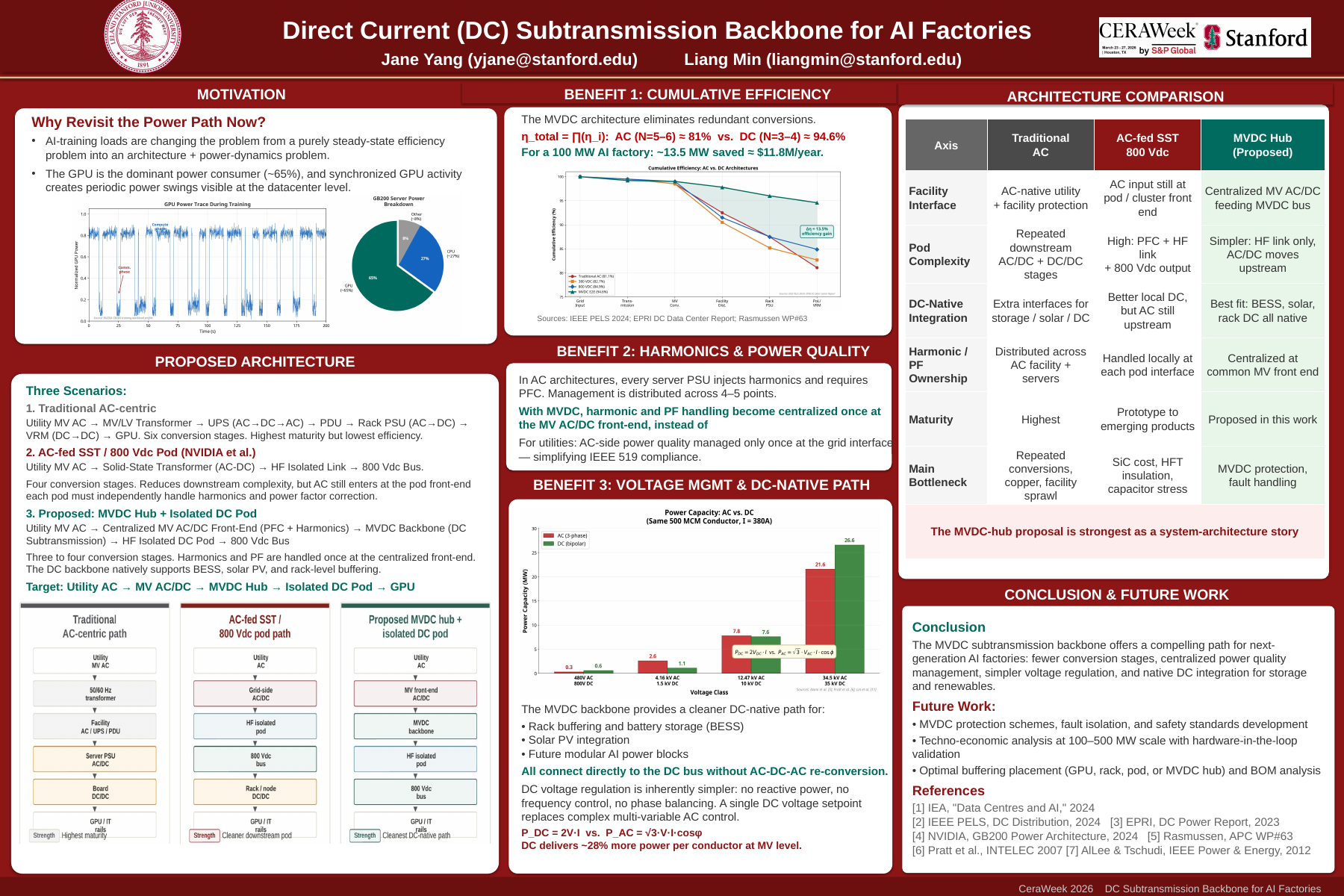
SELECTED PRESENTATION · 2026
Jane Yang and Liang Min
Stanford University · CERAWeek 2026
Original conference-poster version.
03 / BACKGROUND
M.S., Civil & Environmental Engineering
Atmosphere/Energy
M.S., Electrical & Systems Engineering
B.Eng., New Energy Science & Engineering
At Qcells, I developed BESS sizing and techno-economic tools and worked on revenue analysis across four U.S. electricity markets. At GridCARE, I worked in product strategy and business development, translating large-load customer needs into technical evaluation questions and communicating findings with engineering teams.
Through Anima Power, I consult on AI infrastructure and energy storage. Earlier, my undergraduate research focused on solar-integrated biohydrogen production and led to two co-invented patents.
Full background in my CV PDF